Idaho’s backcountry riding is some of the best in the West, and southern Idaho puts you within reach of terrain that ranges from high desert sagebrush flats to alpine singletrack above treeline. The trail systems around City of Rocks, the South Hills, the Albion Range, and the Caribou-Targhee National Forest near Bear Lake draw riders from across the region every season. But before the ride starts, you need to get the machine there, and the trailer you choose determines whether that process is quick and painless or a source of frustration every time you load up. At Grizzly Trailer Sales in Rupert and Montpelier, ATV and UTV trailers are one of our highest-volume categories, and the buying decisions that matter most aren’t the ones most first-time buyers focus on.
The trailer has to match the machine, the tow vehicle, and the terrain you’ll cross to reach the trailhead. Getting any one of those wrong creates problems you’ll deal with on every trip.
The Weight Question Most Buyers Get Wrong
The first mistake recreational trailer buyers make is assuming that a small machine means a small trailer is fine. ATVs and UTVs have gotten significantly heavier over the past decade, and the gap between a lightweight sport quad and a full-size side-by-side is enormous.
A basic sport ATV like a Honda TRX250 weighs around 400 lbs. Two of them on a trailer with fuel and a cooler strapped to the rack puts you at roughly 1,000 lbs of payload. A small single-axle trailer handles this easily, and a midsize truck or SUV with a towing package pulls it without strain.
A full-size utility ATV like a Polaris Sportsman 570 or Can-Am Outlander weighs 700 to 800 lbs. Two of those with full fuel tanks, cargo boxes, and accessories push the payload toward 2,000 lbs. Still manageable for most trailers and tow vehicles, but the margin has narrowed.
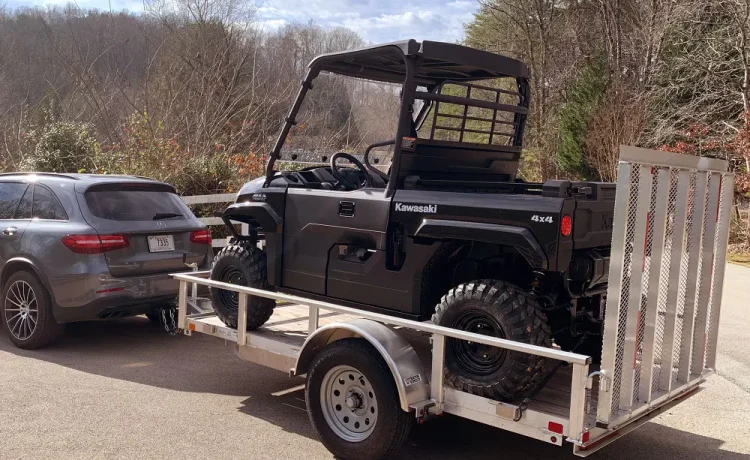
A modern full-size UTV changes the math entirely. A Polaris RZR XP 1000 weighs roughly 1,500 lbs dry. A Can-Am Defender HD10 is over 1,600 lbs. A Polaris General XP 4 with four seats pushes past 1,800 lbs before you add fuel, a spare tire, a cooler, a toolbox, and the recovery gear you should be carrying for backcountry riding. A single full-size UTV loaded for a day trip can easily weigh 2,000 lbs or more. Two of them on a trailer puts you at 4,000 lbs of payload before counting the trailer’s own weight.
A tandem-axle trailer rated at 7,000 lbs GVWR with a 2,200-lb empty weight gives you 4,800 lbs of payload, which handles two loaded UTVs with adequate margin. A single-axle trailer rated at 3,500 lbs GVWR does not. Buyers who purchased their trailer when they owned a pair of sport quads and later upgraded to a side-by-side discover this the hard way, often on the shoulder of Highway 93 with an overloaded axle and a failed bearing.
Know the wet, loaded weight of your machine. Add the weight of everything that rides on it and everything you’ll strap to the trailer. Then verify that the trailer’s payload capacity, not its GVWR, exceeds that number with margin to spare.
Tilt Deck vs. Ramp: Loading Geometry Matters
The loading system is where the decision gets interesting, because it depends on the ground clearance of the machine you’re hauling and the terrain of the trailhead where you’re loading and unloading.
A ramp-style trailer uses a hinged ramp gate at the rear that folds down to create an inclined surface for riding or winching the machine onto the deck. The ramp angle depends on the trailer’s deck height and the ramp length. A trailer with an 18-inch deck height and a 4-foot ramp creates a steep enough angle that low-clearance UTVs can scrape their undercarriage, front bumper, or nerf bars during loading. Longer ramps reduce the angle but add weight and require more clearance behind the trailer when deployed.
A tilt-deck trailer eliminates the ramp angle problem entirely. The entire deck tilts rearward on a pivot point, bringing the back edge of the deck to ground level or close to it. The machine drives on from nearly flat, which makes loading effortless for low-clearance UTVs, heavy machines that are difficult to push up a ramp, and riders who are loading alone without a second person to spot.
Echo and Eagle tilt-deck trailers are among the most popular models we sell at Grizzly Trailer Sales, and the preference for tilt decks is strongest among UTV owners. The trend makes sense: the machines that need the most careful loading are the ones that benefit most from eliminating the ramp angle. For buyers hauling sport ATVs with high ground clearance, a standard ramp trailer works fine and is typically less expensive. For buyers hauling side-by-sides, especially low-slung sport models like the RZR series, a tilt deck is worth the premium.
What Grizzly Trailer Sales Customers Hauling Into Idaho’s Backcountry Prefer
The buying patterns at our Rupert and Montpelier lots track closely with how southern Idaho riders actually use their machines. Riders heading into the South Hills, the Albion Range, or the trail systems accessible from Rock Creek and Magic Mountain are typically running UTVs on Forest Service roads and designated trails. They want a 7×14 tandem-axle tilt deck that handles two loaded machines, tows comfortably behind a half-ton or three-quarter-ton truck, and loads quickly at trailheads where parking is tight and the ground may not be level.
Riders accessing the Caribou-Targhee trails near Montpelier and the Soda Springs area run a similar setup, often with the addition of a spare tire mount because the gravel access roads into some trailheads are rough enough to cut a trailer tire on exposed rock.
ATV-only riders hauling a pair of sport quads for day trips into the desert terrain around City of Rocks or the Snake River canyon rim trails often choose 6×12 or 7×12 single-axle trailers. The machines are lighter, the loading is simpler, and the smaller trailer is easier to maneuver in tight trailhead turnarounds and on narrow access roads.
Tie-Down Strategy and Load Securement
A machine that shifts during transport is a machine that can damage itself, damage the trailer, and create a dangerous towing situation. Securing ATVs and UTVs properly is not optional, and the tie-down points on the trailer need to match the tie-down points on the machine.
D-rings welded to the trailer deck or bolted to the frame rails are the standard anchor points. Their placement should allow straps to pull at approximately 45-degree angles from the machine’s tie-down points to the trailer’s anchor points, creating both downward and lateral restraint. Most ATVs have frame-mounted tie-down points near the front and rear. UTVs typically have cage-mounted or frame-mounted points. Ratchet straps are the standard securement method, and they should be rated for the weight of the machine, not just strong enough to feel tight.
Four straps per machine is the standard for highway transport: two on the front pulling forward and outward, two on the rear pulling rearward and outward. This creates an X pattern of restraint that prevents forward, rearward, and lateral movement. Two straps might hold the machine still on a flat highway, but they won’t hold it when you hit a pothole on a gravel Forest Service road at 35 miles per hour.
Check strap tension at every fuel stop and before descending mountain grades. Straps loosen during transport as the suspension on the machine and the trailer compresses and rebounds over road irregularities. A strap that was tight in the trailhead parking lot may have two inches of slack by the time you reach the highway.
Trailer Features for Idaho Backcountry Access
The conditions between the highway and the trailhead influence which trailer features matter most. Several are worth considering based on how southern Idaho’s access roads and trailheads are configured.
Side rails prevent cargo and gear strapped to the trailer deck from sliding off during transport on rough roads. For riders who carry extra fuel, coolers, recovery gear, or camping equipment alongside the machine, side rails provide a physical barrier that supplements strap securement.
A spare tire mount is a feature that feels unnecessary until a gravel road puts a sidewall gash in your trailer tire eight miles from the nearest pavement. Carrying a mounted spare takes five minutes to install versus waiting hours for a tow or limping out on a damaged tire that risks further damage to the rim and axle.
Fenders are standard on most tandem-axle trailers but worth verifying on single-axle models. Idaho’s Forest Service access roads generate enough dust and gravel spray that a trailer without fenders will sandblast the lower body panels and paint of your tow vehicle on every trip. Fenders also keep road debris from hitting the underside of the machine during transport.
LED lighting is worth confirming on any trailer you buy. LED lights are more durable, more visible, and more resistant to the vibration that kills incandescent bulbs on rough roads. On a trailer that’s going to spend significant time on gravel, LED lighting is a reliability issue, not a cosmetic one.
Match the Trailer to the Machine, the Truck, and the Trip
The right ATV or UTV trailer gets your machine to the trailhead without drama, loads and unloads safely on uneven ground, and holds up to the access roads that connect southern Idaho’s best riding areas to the highway network. Grizzly Trailer Sales carries ATV and UTV trailers from Echo, Eagle, and other brands in both tilt-deck and ramp configurations at our Rupert and Montpelier locations. Tell us what machine you’re hauling, what truck you’re pulling with, and where you ride. We’ll put you on the right trailer for the way you actually use it.